
Financial Operations Onboarding Program
Blended onboarding program designed to prepare new hires for complex, high-risk operational tasks.
Focused on improving readiness and closing the gap between training and real job performance.
Confidentiality Note
Due to confidentiality requirements, specific organization details, program names, and course materials are not shown. Project details focus on design approach, process, and outcomes.

Audience:
New hire financial operations employees
Format:
Instructor-led training, virtual sessions, eLearning, and performance support tools
Tools:
Xyleme, Storyline, enterprise LMS, Microsoft Office, Adobe Acrobat
Role:
Lead Instructional Designer
Project Manager
The Problem
New hires were expected to quickly perform complex workflows across multiple systems, policies, and procedures.
However:
Training was inconsistent and heavily focused on information delivery
Learners had limited opportunities to practice applying knowledge before working independently
At the same time, the project faced additional complexity:
New brand and design standards were introduced mid-development
A new LMS and content platform launched during the project
Team capacity shifted during critical phases
This created a gap between training completion and real job performance.
The Solution
I led the design and development of a structured, two-week onboarding program focused on real job performance.
The program was designed to:
Align training to critical job tasks and workflows
Provide meaningful practice through scenario-based activities
Support performance with job aids and system references
To ensure accuracy and reduce risk, I partnered closely with compliance, legal, and operational stakeholders throughout the project.
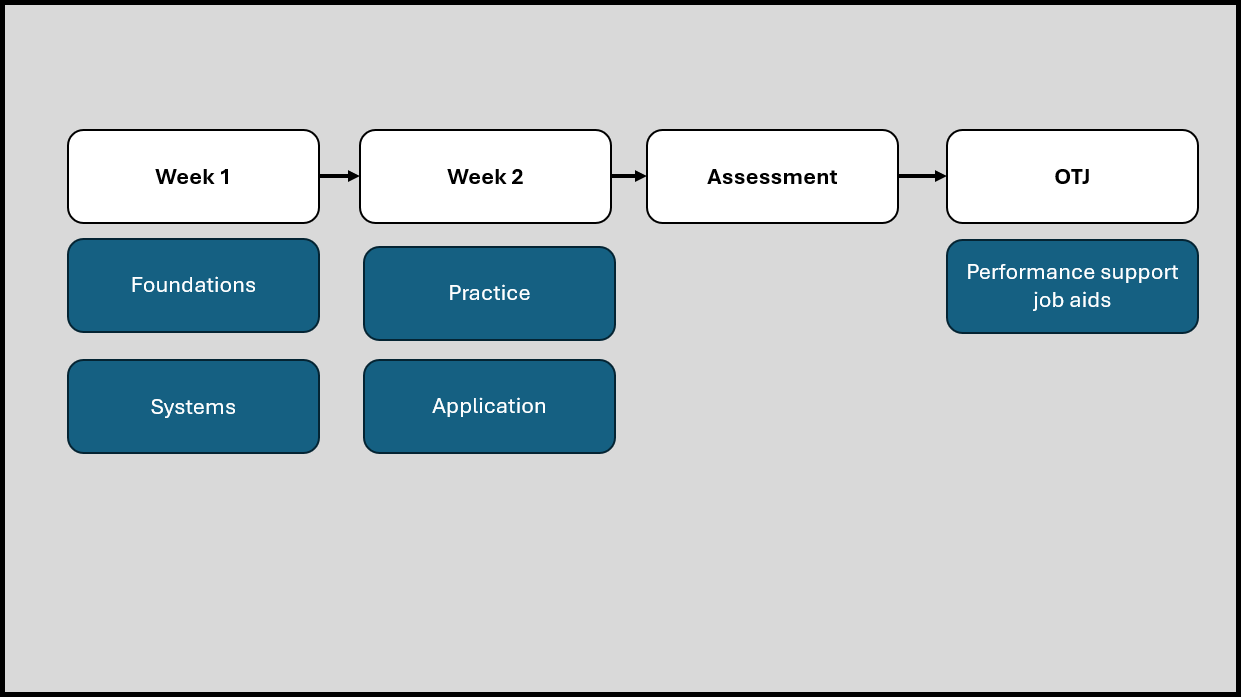
Design approach
This program focuses on applied learning in a complex operational environment through structured practice, task alignment, and flexible delivery.
Performance-Based Design
Conducted interviews with 10+ subject matter experts to identify critical tasks and define the target audience. Aligned all content to real job workflows rather than abstract concepts.
Scenario-based Practice
Designed 11 functional modules with scenario-based knowledge checks, system-based activities, and a structured assessment. Included a review game and applied practice to reinforce decision-making in high-risk tasks.
System and Process Training
Developed training around real systems and tools, supported by reusable screen-based job aids. Reduced duplication by creating shared system reference materials used across modules.
Flexible Delivery Model
Designed the program to be delivered in multiple formats:
Instructor-led
Virtual
Business-led facilitation
This allowed the organization to scale training based on hiring volume.
Design System Thinking
Introduced reusable templates, job aids, and reference materials to improve consistency and reduce development time across the program.
Key Features
A structured two-week onboarding experience designed to build confidence through progressive learning and real-world practice.
Structured Learning Progression
A two-week program that builds knowledge and skills in stages, moving from foundational concepts to applied tasks.
Scenario-Based Practice and Review Activities
Learners apply knowledge through realistic scenarios and guided activities before performing tasks independently.
System-Based Training
Hands-on exposure to core systems and workflows, supported by job aids and real screen examples.
Facilitator and Learner Resources
Comprehensive materials support consistent delivery across instructors and business facilitators.
Performance Support Tools
Job aids, checklists, and reference materials extend learning beyond training into day-to-day work.
My Role
Lead Instructional Designer and Project Manager for a large-scale onboarding program
Defined learning strategy and program structure
Led SME interviews and task analysis
Coordinated timelines, resources, and design efforts
Partnered with compliance and legal stakeholders
Supported adoption of new tools and standards (Xyleme)
Mentored team members and supported platform rollout
Outcome
This program improved both learner readiness and operational efficiency across the organization.
Delivered a full onboarding program on time despite evolving requirements
Improved alignment between training and real job tasks, accelerating time to independent performance
Reduced content duplication by centralizing system reference materials
Enabled scalable delivery across instructor-led, virtual, and business-led formats
Increased efficiency for future updates through reusable templates and job aids
Strengthened compliance alignment through ongoing stakeholder collaboration
Reflection
Reinforced the importance of designing for performance in complex environments
Required balancing evolving standards, tools, and team capacity through prioritization and stakeholder alignment
Highlighted the value of reusable design systems and job aids in improving both efficiency and learner experience
Select the link below to view the next project.